

NeoSilvan’s U.S. patented table base design connects a practical woodworking perspective with a distinctive ornamental form. The signature Spider Table Base brings crossed arms into a compact central composition beneath the tabletop. U.S. Design Patent No. D1,052,319 S, titled TABLE BASE, was granted November 26, 2024. That milestone concerns the specific appearance shown in the patent drawings, rather than a certification of structural performance.
The space beneath the tabletop is part of the design
A wood tabletop has a strong visual presence: its edge, grain, thickness, and outline establish the character of the piece. The base determines how that presence meets the floor. It can echo the top, provide a contrasting geometry, or create an open area that lets the wood’s outline remain prominent.
Many years of woodshop and solid wood furniture experience gave NeoSilvan an interest in that relationship. The base was not simply an item to be selected after the wood was chosen. It was an opportunity to develop a recognizable furniture foundation, with its own proportions and visual identity.
That perspective led to a significant investment of effort and resources in our signature design direction. The company’s origin story explains the broader decision. Here, the focus is on the form itself and what the patent milestone accurately says about it.
Reading the Spider Table Base’s crossed-arm geometry
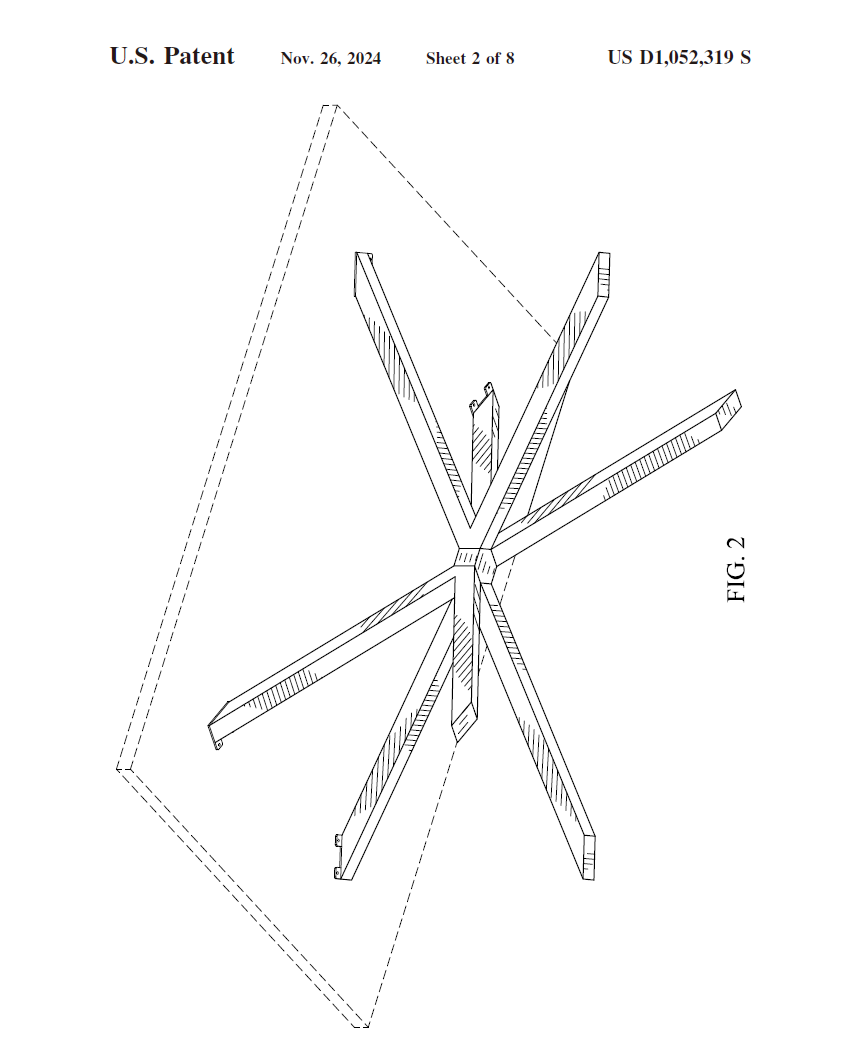
The NeoSilvan Spider Table Base uses angled arms that converge around a central junction. The resulting silhouette changes with the viewing angle: some arms overlap, others separate, and the open areas between them become part of the composition.
With a substantial wood top, that geometry creates a visual conversation between the broad horizontal surface and the form below. The tabletop’s natural grain and irregularities can contrast with the base’s defined lines. The base remains visible without needing an ornamental skirt around the top’s edge.
These are observations about appearance, not claims that crossed arms automatically make every table stronger or more suitable. The relationship between a particular top and base still needs review. Seating clearance, actual dimensions, mounting, and intended use remain practical requirements alongside the visual choice.
The verified patent milestone
The patent reference for this design is:
- U.S. Design Patent No. D1,052,319 S.
- Patent title: TABLE BASE.
- Grant date: November 26, 2024.
- Subject: the specific ornamental table base design shown in the patent drawings.
The approved FIG. 2 drawing provides a view of that design. Its purpose in this story is to show the documented form alongside the real product, without presenting an entire patent certificate or turning a legal record into a performance badge.
The USPTO’s design patent guidance explains the distinction between ornamental appearance and an article’s functional characteristics. That distinction matters when a furniture buyer encounters a patent reference in a product description.
What the patent does not establish
A design patent does not certify load capacity, engineering safety, material quality, or manufacturing quality. It is not a substitute for product specifications, installation instructions, or a review of the complete furniture configuration. The grant date is a design milestone, not a date on a structural test report.
It also does not mean all spider-style table bases are patented. “Spider” describes a broader visual category used for different products. NeoSilvan’s patent identification here is limited to the specific design and the matching signature product, rather than applied to unrelated bases in the catalog.
Nor does a U.S. patent establish a product’s manufacturing location. We use the patent’s jurisdiction accurately, without converting it into an American-made claim. Design protection, production origin, and product performance are separate facts that should be described separately.
Pairing an original form with the actual wood top
To assess the visual pairing, compare the base with the actual top in plan view and at normal seated height. Consider how the crossed arms relate to the top’s length, width, and edge shape. A centered catalog photograph is useful for understanding the product, but it cannot settle every proportion or seating question for your room.
Then examine the practical pairing: the underside construction, attachment areas, hardware approach, finished height, chair positions, and floor conditions. Our guide to what woodshop experience teaches about table stability explains why those details belong together.
Where a suitability claim needs more context, ask for it. The companion article on unverified table base weight ratings offers a buyer’s checklist. An original appearance and a careful specification conversation should support one another without being confused for the same kind of evidence.
Explore the design, then discuss your project
NeoSilvan offers the signature Spider design within a broader furniture offering that includes metal table bases, acrylic foundations, and solid wood tables. These links describe the wider catalog; the patent statement above does not extend to every product in those collections.
For a custom inquiry, share the actual top’s dimensions and material, available weight information, underside photographs, and the intended dining or conference use. Suitable options, availability, pricing, and lead times depend on the project details and require confirmation.
Learn about NeoSilvan, explore more stories in the NeoSilvan Journal, or start a custom project. The aim is a table whose visual identity and practical planning receive equal attention.